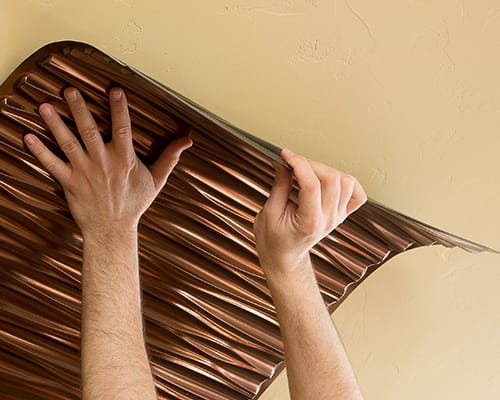
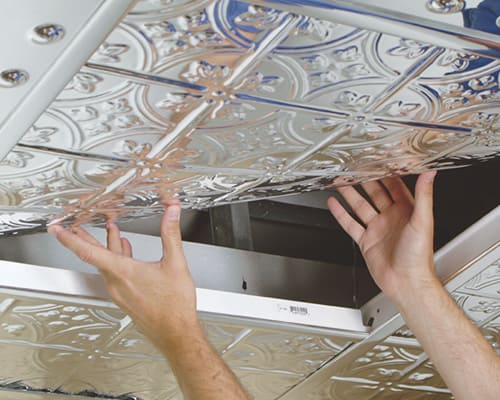
Fasade waves ceiling tiles in white

ceiling installation for glue-up and lay-in applications

Glue-Up Ceiling Installation

Please read these installation instructions in their entirety before beginning your installation.

  • Determine the room layout. To ensure the room looks balanced, the panels should be centered in the room and the border tiles should all be the same size. The large indentations in the styles, Traditional 3, Art Deco, Rosette, Coffer and Dome prevent them from being cut in the middle and resting properly at the border areas. Accordingly, these styles look best when the Border Fill style panels are used on the perimeter of the room. The remaining Fasade panel styles look best when the full-size panels are cut for the border (not the Border Fill panels). If the existing border panel width is less than 12”, two border panels can be cut out of one full-sized panel.

  • Install the border panels. Using the length of border panel dimension you determined in the step above, snap a chalk line as a reference point. Repeat this in the opposite direction for the width side of the room. This will balance the room. Using this chalk line layout, measure and cut the border panel by scoring the finish side of the panel with a utility knife and straight edge. Bend the panel at the score mark to snap apart. Another option for cutting the panels is to use a tin snip and cut along a marked line. After cutting the panel to size and before applying glue, it is recommended that you remove the protective film.
  • The preferred method for installing Glue-Up ceiling panels is to use a notched trowel (1/4″ x 1/4″ x 3/4″) and apply the adhesive directly to the ceiling. ACP, the manufacturer of Fasade recommends using Henry 444 FRP Panel Adhesive.

Recommended trowel

  • Let the panels acclimate to room temperature for 12-24 hours before installing. Spread adhesive over the ceiling surface using the recommended trowel. Do not leave bare spots. Do not trowel on more adhesive than you can cover with panels in 30 minutes. Press down firmly on the trowel so that adhesive does not remain between ridges. Place panel against troweled ceiling. Press firmly over entire surface working from center to edges so that entire back of panel is in full contact with backing.

  • Overlap the first 3/8” of the subsequent border panels where the ridges and dots align. Complete one set of border panels in each of the length and width directions in the room.

Install full panels. For the best appearance, before installing the first full row of panels and subsequent rows of panels, cut the corner bumps off of the two overlapping panels previously installed. Start at the corner farthest from the main entrance of the room, and working in rows across the room, install the full panels by overlapping each new row over the previous row. Complete each row by cutting and installing the remaining border panels.

Tip 1: You must remove any adhesive that gets on the finish side of the ceiling panel before it dries, using a damp cloth. If you cannot remove excess adhesive with a damp cloth you can use mineral spirits. Mineral spirits is the only thing that can be used that will not damage the finish on the panel.

Tip 2: One hour after the ceiling has been completed, firmly press on ALL the ceiling panels you’ve installed to ensure proper bonding and adhesive set-up.

Tip 3. Prior to ceiling tile installation, it is recommended that the entire ceiling be smooth and flat. Apply a drywall primer or paint primer.

Tip 4. Edge J-Trims are available to purchase for finishing off the wall edges. If using the Edge J-Trim, screw the trim up to the ceiling before installing the ceiling panels.

Tip 5. Clean only with warm, soapy water. Never use abrasive cleaners such as; Scotchbrite Pads or Brillo Pads, etc. They may harm the finish on the panels. Using a high-quality auto polish can help protect the finish.

Note: If custom wood trim or other molding will be used, J-Trim will not be necessary. Install trim after the ceiling is complete.

CAUTION: Even though these decorative panels are “Class A” fire rated, they can be deformed with excessive heat. Never expose to heat over 140°F.

Lay-In Ceiling Installation

  • Determine the number of tiles required. When installing in an existing suspended ceiling, count the number of whole panels and the number and size of border panels. If installing a new grid system, perform the same count from your grid layout plan. The large indentations in the styles, Traditional 3, Art Deco, Rosette, Coffer and Dome, prevent them from being cut in the middle and resting level on the grid at the border areas. Accordingly, these styles look best when the Border Fill or Flat Panel styles are used around the perimeter of the room. The remaining styles look best when the full-size style panels are cut for the borders (not the Border Fill panels). If the existing border panel width is less than 12”, two border panels can be cut out of one full-size panel.
  • Installing the border panels.  Measure the distance from the center of the T-Bar and the closest edge of the wall molding. Using a utility knife and a straight edge, score the finish side of the panel at this measurement. Bend the panel at the score mark to snap apart. Tilt on an angle and insert the new tile underneath the existing ceiling panel. When installing the panels, place small amounts of adhesive on the back side of the Fasade panel to reduce sag, if needed.
  • Installing full panels. Working across the room, install the full panels using the same technique. When installing the panels, place small amounts of adhesive on the back side of the Fasade panel to reduce sag, if needed.
  • Clean-up. Once you have your ceiling installed, the decorative panels can be cleaned with warm, soapy water. Never use abrasive cleaners such as; Scotchbrite Pads or Brillo Pads, etc. They may harm the finish on the panels. Using a high-quality auto polish can help protect the finish.

Tip 1. For best acoustics, airflow stabilization and panel stability, it is recommended that the Fasade panels be installed underneath a mineral board ceiling tile or some other material to weigh the panel down. You may consider purchasing an economical lay-in mineral board ceiling tile for this purpose. When installing Fasade panels with HG-Grid vinyl suspension system, the panels must be installed with mineral board ceiling tiles on top to ensure proper stability of the entire grid system.

Tip 2. Clean only with warm, soapy water. Never use abrasive cleaners such as; Scotchbrite Pads or Brillo Pads, etc. They may harm the finish on the panels. Using a high-quality auto polish can help protect the finish.

Tip 3. If installing Ceiling Grid Covers, install the grid covers prior to installing the ceiling panels. Consult GridMAX installation guide for the necessary steps.

CAUTION: Even though these decorative panels are “Class A” fire rated, they can be deformed with excessive heat. Never expose to heat over 140°F.